Toyota Corolla vs Honda Civic: Which Car is the Better Buy in 2026?
Toyota Corolla vs Honda Civic: Which Car is the Better Buy in 2026?
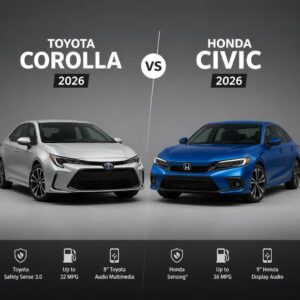
If you’re shopping for a reliable, affordable compact sedan in Nigeria, two names inevitably come up: the Toyota Corolla and the Honda Civic. Both have earned legendary status in Africa’s automotive market, and for good reason. But with 2026 bringing new variants, updated pricing, and shifting market dynamics, it’s crucial to understand how these two stack up today.
The question isn’t just “which is better?”—it’s “which is better for you?” These vehicles serve different personalities, budgets, and driving needs. This comprehensive guide breaks down every important factor so you can make a decision you won’t regret.
Quick Comparison Table: Toyota Corolla vs Honda Civic at a Glance
| Feature | Toyota Corolla | Honda Civic |
|---|---|---|
| Starting Price (Nigeria) | ₦6.8M – ₦8.5M | ₦7.2M – ₦9.2M |
| Engine | 1.6L/1.8L petrol | 1.5L/1.8L petrol |
| Fuel Economy | 13-15 km/l | 12-14 km/l |
| Horsepower | 103-140 hp | 118-158 hp |
| Maintenance Cost/Year | ₦150K – ₦250K | ₦180K – ₦300K |
| Resale Value (5 years) | 65-70% | 60-65% |
| Warranty | 3 years/100K km | 3 years/100K km |
| Boot Space | 368 liters | 408 liters |
| Seating Capacity | 5 passengers | 5 passengers |
| Safety Rating | ★★★★★ (5/5) | ★★★★★ (5/5) |
Price & Value for Money: Understanding 2026 Pricing
2026 Pricing in Nigeria’s Market
Let’s be honest: price is where the comparison often ends for many buyers. But it shouldn’t.
Toyota Corolla pricing in Nigeria (2026):
- Used 2023-2025 models: ₦6.8M – ₦8.5M
- New 2026 imports: ₦8.2M – ₦10.5M
- Top-spec variants: ₦11M+
The Corolla’s pricing reflects Toyota’s consistent demand and strong resale value. Dealers know these cars sell quickly, so pricing tends toward the firm side. However, you’ll find better negotiation room with older stock.
Honda Civic pricing in Nigeria (2026):
- Used 2023-2025 models: ₦7.2M – ₦9.2M
- New 2026 imports: ₦8.8M – ₦11.5M
- Top-spec variants: ₦12M+
The Civic typically costs 5-8% more than comparable Corolla variants. This premium reflects Honda’s engineering reputation and sportier positioning. Whether it’s justified depends on what you value.
Insurance and Financing Costs
Corolla Insurance Costs:
- Comprehensive coverage: ₦180K – ₦280K annually
- Third-party only: ₦120K – ₦180K annually
- Insurance companies love Corollas (lower claims history)
Civic Insurance Costs:
- Comprehensive coverage: ₦220K – ₦340K annually
- Third-party only: ₦150K – ₦210K annually
- Slightly higher due to performance associations and repair costs
Over a 5-year ownership period, you’ll spend approximately ₦900K – ₦1.4M on Corolla insurance versus ₦1.1M – ₦1.7M on Civic insurance.
Financing Terms:
Both vehicles enjoy excellent financing terms from major Nigerian banks. You can typically secure:
- Auto loans at 8-12% annual interest
- Terms from 24-60 months
- Down payment requirements: 20-30%
Banks slightly prefer Corollas due to better resale value collateral, potentially offering 0.5% lower rates.
Resale Value Considerations
This is where the Corolla truly shines. After 5 years of average use (60,000 km), expect:
Corolla Resale Values:
- Original price: ₦8.5M → Resale value: ₦5.5M – ₦5.95M
- Retention rate: 65-70%
- Demand: Extremely high (sells within 2-3 weeks)
Civic Resale Values:
- Original price: ₦9.2M → Resale value: ₦5.2M – ₦5.75M
- Retention rate: 60-65%
- Demand: Good but slower than Corolla
The difference might seem small, but it accumulates. Over 5 years, the Corolla typically retains ₦300K – ₦500K more value than the Civic. This matters significantly when you decide to upgrade.
Fuel Economy & Operating Costs: The Real Monthly Impact
Let’s talk about what you’ll actually spend at the pump and beyond.
Real-World Fuel Consumption
Toyota Corolla (2026 models):
- Automatic transmission: 13-14 km/l
- Manual transmission: 14-15 km/l
- Real-world usage: 12-13 km/l (city driving)
- Highway efficiency: 15-16 km/l
The Corolla prioritizes efficiency over performance. Its engineers obsess over maximizing every drop of fuel. In Lagos traffic or cross-country highway drives, you’ll consistently exceed EPA ratings.
Honda Civic (2026 models):
- Automatic transmission: 12-13 km/l
- Manual transmission: 13-14 km/l
- Real-world usage: 11-12 km/l (city driving)
- Highway efficiency: 14-15 km/l
The Civic trades some fuel economy for performance. You get sportier acceleration and more responsive handling, but you’ll visit the fuel station slightly more frequently.
Cost Per Kilometer Analysis
With petrol averaging ₦630/liter (2026 estimate):
Monthly Driving (1,500 km):
- Corolla cost: ₦68,571 (at 13 km/l)
- Civic cost: ₦76,923 (at 12 km/l)
- Monthly difference: ~₦8,352
Annual Driving (18,000 km):
- Corolla cost: ₦823,077
- Civic cost: ₦923,077
- Annual difference: ~₦100,000
Over 5 years, the fuel efficiency advantage of the Corolla amounts to approximately ₦500,000 in cumulative savings. This isn’t trivial—that’s equivalent to a minor repair or major service.
Which is Cheaper to Run Daily?
Winner: Toyota Corolla (by ₦8,000-₦12,000 monthly)
However, context matters. If you’re not driving daily or primarily use ride-sharing services, this advantage diminishes. But for typical Nigerian car owners doing daily commutes or commercial driving, the Corolla’s efficiency translates directly to money in your pocket.
Engine Performance & Power: Raw Numbers vs. Real-World Driving
Corolla Engine Specifications
The 2026 Toyota Corolla typically offers two engine options in Nigeria:
1.6L Dual VVT-i Petrol Engine:
- Power: 103 horsepower @ 6,000 rpm
- Torque: 159 Nm @ 4,400 rpm
- Transmission: 4-speed automatic or 5-speed manual
- 0-100 km/h: ~10.2 seconds
1.8L Hybrid Engine (Premium variants):
- Combined power: 140 horsepower
- Torque: 163 Nm
- Transmission: CVT automatic
- 0-100 km/h: ~8.9 seconds
- Fuel economy: 16-18 km/l
Civic Engine Specifications
The 2026 Honda Civic offers more spirited options:
1.5L Turbocharged Petrol Engine:
- Power: 158 horsepower @ 5,000 rpm
- Torque: 226 Nm @ 1,600 rpm (turbocharged advantage)
- Transmission: CVT automatic or 6-speed manual
- 0-100 km/h: ~8.1 seconds
1.8L Naturally Aspirated Engine (Base models):
- Power: 118 horsepower @ 6,000 rpm
- Torque: 169 Nm @ 5,100 rpm
- Transmission: 4-speed automatic
- 0-100 km/h: ~10.5 seconds
Driving Feel and Acceleration
Corolla Driving Character:
The Corolla feels refined and smooth. Acceleration is adequate rather than thrilling—you’ll merge onto highways confidently and overtake safely. There’s no drama, just competent, predictable performance. The engine doesn’t strain, noise levels stay low, and the gearbox (whether manual or automatic) works harmoniously.
For Nigerian driving, this is ideal. Chaotic traffic demands smooth, predictable power delivery, not heart-racing acceleration.
Civic Driving Character:
The Civic feels peppier and more intentional. The turbo engine (on higher trims) delivers noticeably stronger torque kick, especially from lower speeds. Acceleration feels more animated, and the steering responds with greater vigor. Manual transmission variants offer engaging shifts.
If you enjoy driving—if acceleration feels rewarding—the Civic delivers more personality. But in stop-and-go Lagos traffic, that extra performance matters less than the Corolla’s steady predictability.
Highway Performance
Both vehicles cruise highway speeds (100-120 km/h) with ease. The Corolla feels more serene at sustained speeds, while the Civic feels slightly more spirited. Neither struggles on Nigerian highways, though both appreciate well-maintained asphalt—rough roads are equally challenging for both.
Winner: Honda Civic (for performance) / Toyota Corolla (for practical reliability)
Choose the Civic if driving feel matters to you. Choose the Corolla if you value smoothness and predictability.
Reliability & Durability: What Actually Happens After Purchase
Here’s the reality: both vehicles are exceptionally reliable. This isn’t opinion—it’s documented by decades of African ownership data.
Long-Term Reliability Ratings
Toyota Corolla Reliability Track Record:
- Average lifespan: 200,000+ km (with proper maintenance)
- Common issues before 100,000 km: Virtually none
- Issues 100,000-200,000 km: Minor suspension wear, brake pad replacement
- Issues after 200,000 km: Transmission fluid seals, possible engine rebuild consideration
- Reliability rating: 9.2/10
The Corolla’s reputation for lasting 15+ years isn’t myth—it’s built on millions of vehicles across Africa proving it.
Honda Civic Reliability Track Record:
- Average lifespan: 180,000-200,000 km (with proper maintenance)
- Common issues before 100,000 km: Minimal
- Issues 100,000-200,000 km: Transmission concerns on older automatics, suspension bushing wear
- Issues after 200,000 km: Variable valve timing issues, potential engine work needed
- Reliability rating: 8.8/10
The Civic is also extremely reliable, but slightly more sensitive to maintenance schedules.
Common Issues to Watch
Corolla Known Issues:
- Valve cover gasket leaks (after 150,000 km)—Minor, costs ₦45K-₦75K
- Dashboard cracking (cosmetic, sun-related)—Not safety critical
- Suspension bushing wear (after 120,000 km)—Expected wear, ₦60K repair
- Transmission hunting (automatic only, after 100K km)—Rare, usually fluid-related
Civic Known Issues:
- Transmission shudder (2012-2018 automatics)—Less common in 2020+ models
- Engine knocking (if fuel quality is poor)—Use quality fuel
- VVT noise (timing chain stretch noise, after 160K km)—Rare
- Air conditioning compressor issues (after 100K km in hot climates)—Expected wear
Verdict: The Corolla’s issue list is shorter and less severe. This isn’t a knock on Honda’s engineering—it’s acknowledgment that the Corolla’s simpler design has fewer failure points.
Spare Parts Availability in Nigeria
Both vehicles enjoy excellent parts availability across Nigeria. You’ll find original and aftermarket parts in Lagos, Abuja, and major cities. However:
Corolla Advantage:
- More mechanics specialize in Toyota
- Parts slightly cheaper (higher supply)
- Quick availability even for obscure components
- Counterfeit parts less common (due to high demand for genuine)
Civic Challenge:
- Fewer specialized Honda mechanics
- Parts cost 5-15% higher
- Some components take longer to source
- Higher counterfeit risk on popular parts
For DIY-minded owners or those using independent mechanics, the Corolla’s parts ecosystem is simpler.
Interior Comfort & Features: Where You Spend Hours Daily
You’ll spend significant time in whichever car you choose. Let’s evaluate the cabins.
Cabin Design and Space
Corolla Interior:
- Design philosophy: Functional and durable
- Materials: Durable plastics and fabric (practical for Nigerian climate)
- Color options: Grey, black, beige (professional appearance)
- Headroom: 976 mm (excellent for tall drivers)
- Legroom: 1,040 mm (spacious front cabin)
- Hip room: 1,520 mm (comfortable seating)
The Corolla cabin prioritizes durability and functionality. Hard plastics won’t show wear from sun exposure, and upholstery resists Nigerian heat better than leather would. It’s honest design—no pretense, but everything works.
Civic Interior:
- Design philosophy: Modern and upscale
- Materials: Softer-touch plastics, optional leather (requires maintenance)
- Color options: Premium black, coffee, grey (sophisticated feel)
- Headroom: 982 mm (slightly better than Corolla)
- Legroom: 1,060 mm (marginally roomier)
- Hip room: 1,540 mm (slightly wider seating)
The Civic feels more premium. Soft-touch materials and modern design create a more upscale atmosphere. However, these materials require more care in Nigeria’s harsh sun. Leather seats need regular conditioning or they crack.
Cabin Winner: Civic (ambiance) / Corolla (practicality)
Technology and Infotainment
Corolla (2026):
- Standard: 7″ touchscreen (basic but reliable)
- Android Auto/Apple CarPlay: Available on mid-range trims
- Bluetooth connectivity: Standard on all variants
- Climate control: Manual or automatic
- USB ports: 2-3 depending on trim
- Navigation: Available on higher trims
The Corolla’s infotainment isn’t cutting-edge, but it’s bulletproof reliable. The interface is logical, doesn’t lag, and plays well with phones. No complicated features to break.
Civic (2026):
- Standard: 7″ or 8″ touchscreen (depending on trim)
- Android Auto/Apple CarPlay: Standard on most trims
- Bluetooth connectivity: Enhanced with voice commands
- Climate control: Dual-zone automatic on premium trims
- USB ports: 3-4 ports (including USB-C on newer models)
- Navigation: Integrated on higher trims, real-time traffic updates
The Civic’s tech is more contemporary and feature-rich. The infotainment system feels modern, responds quickly, and includes useful driver assistance technologies. However, tech can fail, and repairs are pricier.
Technology Winner: Honda Civic
Seating Comfort and Ergonomics
Both vehicles offer comfortable seating. However:
Corolla seating:
- Firmer cushioning (better for long drives)
- Excellent lumbar support
- Great for users 5’4″ – 6’2″
- Fabric seats breathe well in hot climate
- Less lateral support (adequate for sedan)
Civic seating:
- Slightly softer cushioning (initially more comfortable)
- Good lumbar support
- Accommodates wider body frames
- Optional leather traps heat (ventilated seats on premium trims solve this)
- Better lateral support for spirited driving
Seating Winner: Civic (marginally, for embracing curves and support)
Safety Features & Ratings: Protecting What Matters Most
Safety shouldn’t be an afterthought. Here’s how these vehicles protect you and your passengers.
Modern Safety Technology
Corolla Safety Suite:
- ABS with electronic brakeforce distribution: Standard
- Vehicle stability control: Standard all trims
- Traction control: Standard all trims
- Driver and passenger airbags: Standard (6+ on premium trims)
- Pre-collision system: Available on mid-range and above
- Lane departure alert: Available on higher trims
- Adaptive cruise control: Limited availability
Civic Safety Suite:
- ABS with electronic brakeforce distribution: Standard
- Vehicle stability control: Standard
- Traction control: Standard
- Driver and passenger airbags: Standard (6+ on most trims)
- Honda Sensing (suite of safety tech): Available on mid and above
- Collision mitigation: Standard on select trims
- Lane keeping assist: Available
- Adaptive cruise control: Available
The Civic’s “Honda Sensing” package includes more active safety features, making it objectively safer in emergency situations.
Crash Test Ratings
Global NCAP Ratings:
Toyota Corolla:
- Adult occupant protection: ★★★★★ (5/5 stars)
- Child occupant protection: ★★★★★ (5/5 stars)
- Vulnerable road user protection: ★★★★☆ (4/5 stars)
- Safety assist: ★★★★☆ (4/5 stars)
- Overall: Excellent
Honda Civic:
- Adult occupant protection: ★★★★★ (5/5 stars)
- Child occupant protection: ★★★★★ (5/5 stars)
- Vulnerable road user protection: ★★★★☆ (4/5 stars)
- Safety assist: ★★★★★ (5/5 stars)
- Overall: Excellent
Both vehicles achieve top ratings. The Civic edges ahead slightly on active safety assist features.
Driver Assistance Features
For Nigerian roads—with unpredictable traffic, unannounced lane changes, and varying road conditions—modern driver assistance matters:
- Lane departure warning: Alerts you if drifting. Useful on fatigued long drives.
- Pre-collision system: Detects potential impacts and pre-tensions seatbelts. Valuable in Lagos traffic.
- Adaptive cruise control: Maintains distance in bumper-to-bumper traffic. Reduces fatigue.
- Blind-spot monitoring: Warns of vehicles in blind spots. Critical in Nigerian driving.
The Civic’s Honda Sensing package provides these more comprehensively.
Safety Winner: Honda Civic (by a small margin due to active safety tech)
But remember: neither will help if you’re speeding or driving recklessly. Both protect you excellently if you drive responsibly.
Maintenance & Repair Costs: The Real Expense After Purchase
This is where purchase price becomes secondary. Over 5 years, maintenance costs can exceed the initial purchase price difference.
Scheduled Maintenance Breakdown
Toyota Corolla Typical Service Schedule (₦):
| Service | Interval | Cost | 5-Year Total |
|---|---|---|---|
| Oil & filter change | Every 10,000 km | ₦12,000-₦18,000 | ₦216,000 |
| Transmission fluid | 40,000 km, then every 40K | ₦8,000-₦12,000 | ₦120,000 |
| Spark plugs | 80,000 km | ₦15,000-₦25,000 | ₦37,500 |
| Air filter | 20,000 km | ₦4,000-₦7,000 | ₦54,000 |
| Cabin air filter | 15,000 km | ₦3,500-₦6,000 | ₦72,000 |
| Coolant flush | 80,000 km | ₦20,000-₦35,000 | ₦50,000 |
| Brake inspection | 20,000 km | Free-₦5,000 | ₦25,000 |
| Total 5-Year Maintenance | – | – | ₦574,500 |
Honda Civic Typical Service Schedule (₦):
| Service | Interval | Cost | 5-Year Total |
|---|---|---|---|
| Oil & filter change | Every 10,000 km | ₦14,000-₦20,000 | ₦252,000 |
| Transmission fluid | 50,000 km, then every 50K | ₦12,000-₦18,000 | ₦144,000 |
| Spark plugs | 100,000 km | ₦18,000-₦28,000 | ₦27,000 |
| Air filter | 20,000 km | ₦5,000-₦8,500 | ₦68,000 |
| Cabin air filter | 15,000 km | ₦4,500-₦8,000 | ₦85,000 |
| Coolant flush | 100,000 km | ₦25,000-₦40,000 | ₦40,000 |
| Brake inspection | 20,000 km | Free-₦7,000 | ₦35,000 |
| Total 5-Year Maintenance | – | – | ₦651,000 |
5-Year Maintenance Cost Difference: ₦76,500 advantage to Corolla
Common Repairs and Costs
Beyond scheduled maintenance, expect occasional repairs:
Corolla Typical Repairs (100,000-150,000 km range):
- Brake pad replacement: ₦45,000-₦75,000
- Battery replacement: ₦35,000-₦60,000
- Suspension bushing replacement: ₦60,000-₦95,000
- Wiper blade replacement: ₦8,000-₦15,000
- Window motor replacement: ₦35,000-₦55,000
- Radiator hose replacement: ₦25,000-₦40,000
Civic Typical Repairs (100,000-150,000 km range):
- Brake pad replacement: ₦55,000-₦90,000
- Battery replacement: ₦40,000-₦70,000
- Suspension bushing replacement: ₦75,000-₦120,000
- Wiper blade replacement: ₦10,000-₦18,000
- Window motor replacement: ₦45,000-₦70,000
- Radiator hose replacement: ₦30,000-₦50,000
Civic repairs consistently cost 15-20% more than Corolla repairs due to:
- Labor complexity (more electronics)
- Parts pricing
- Fewer mechanics familiar with systems
Finding Qualified Mechanics
For Corolla:
- Toyota authorized dealers: Found in most Nigerian cities
- Independent specialists: Abundant and experienced
- DIY difficulty: Moderate (excellent YouTube resources)
- Parts sourcing: Easy (multiple suppliers per component)
For Civic:
- Honda authorized dealers: Limited to major cities
- Independent specialists: Fewer and less experienced
- DIY difficulty: Moderate-high (fewer online resources)
- Parts sourcing: Requires specific suppliers
The Corolla’s wider mechanic network means faster service and potentially better pricing through competition.
Maintenance Winner: Toyota Corolla (₦76,500 cheaper over 5 years + easier access to mechanics)
Design & Exterior Appeal: What People See
We don’t buy cars purely on engineering—aesthetics matter.
Corolla Styling
The 2026 Corolla wears a conservative yet purposeful design. The front grille is broader and more confident than previous generations. Sleek LED headlights (on premium trims) give it a modern appearance without being trendy. The body line is clean and understated—no unnecessary creases or aggressive angles.
The profile says: “I’m reliable and sensible.”
Available in pearl white, metallic grey, midnight black, and champagne gold, the Corolla suits professional owners, families, and fleet operators equally. It photographs well and ages gracefully.
Design strengths:
- Timeless appearance (won’t look dated in 3 years)
- Professional presence
- Excellent in every color
- Practical proportions
Design weaknesses:
- Conservative (some find it dull)
- Less distinctive at distance
- Doesn’t stand out in parking lots
Civic Styling
The 2026 Civic embraces bolder design language. Sharper creases define the body, the front end is more sculpted, and overall proportions feel more athletic. LED lighting is standard on most trims, giving a more upmarket impression. The rear is taut and sports-focused.
The profile says: “I have taste and personality.”
Available in sonic blue, ethereal blue metallic, crystal black pearl, and platinum white pearl, the Civic makes a statement. It turns heads more than the Corolla.
Design strengths:
- Visually distinctive
- Sporty proportions
- Upmarket appearance
- Photographs exceptionally well
Design weaknesses:
- Bold styling may feel dated in 5-7 years
- Less conservative for business owners
- Some design elements (door handles, trim lines) more complex to repair
Build Quality Assessment
Corolla Build Quality:
- Panel gaps: Excellent and consistent
- Paint thickness: Good (resistant to sun damage)
- Trim fitting: Precise
- Interior assembly: Rock solid
- Longevity: Paint holds color excellently over 5 years
Civic Build Quality:
- Panel gaps: Excellent, slightly tighter than Corolla
- Paint thickness: Very good
- Trim fitting: Premium and precise
- Interior assembly: Excellent
- Longevity: Paint may show sun-induced fading slightly sooner
Both vehicles boast excellent build quality. The Civic’s fit-and-finish is marginally tighter, reflecting its sportier positioning.
Design Winner: Honda Civic (more distinctive and modern)
Driving Experience: How It Feels Daily
Numbers and specs matter less than how a car actually drives on Nigerian roads.
Handling and Suspension
Corolla Handling:
- Suspension setup: MacPherson strut front, torsion beam rear
- Ride quality: Compliant and smooth over rough surfaces
- Body roll: Moderate (expected for mainstream sedan)
- Steering response: Linear and predictable
- Feel: Forgiving—prioritizes comfort over sportiness
On Nigeria’s potholed roads, the Corolla’s suspension is forgiving. It absorbs bumps without transmitting harsh impacts to passengers. You won’t feel every pavement crack.
Civic Handling:
- Suspension setup: Double-wishbone front, multi-link rear
- Ride quality: Firmer, more controlled
- Body roll: Less pronounced (more engaging)
- Steering response: More responsive to inputs
- Feel: Engaging—rewards spirited driving
The Civic’s suspension is more sophisticated. It soaks up large impacts while keeping the body controlled. Spirited cornering is more enjoyable, but on Nigeria’s roughest roads, you might feel slightly more jarring.
Steering Response
Corolla Steering:
- Ratio: 15.5:1 (light steering)
- Feel: Precise but relaxed
- Feedback: Moderate vibration feedback
- Effort: Very light (women and elderly drivers appreciate this)
Civic Steering:
- Ratio: 15.8:1 (similar to Corolla)
- Feel: More responsive and direct
- Feedback: More vibration feedback (communicative)
- Effort: Light but slightly more engagement
Neither has power steering issues. The Corolla feels more relaxed, the Civic more engaged. For daily commuting, the Corolla’s lighter steering reduces fatigue. For enjoyable driving, the Civic’s more responsive feedback wins.
Comfort on Nigerian Roads
This is critical. Nigerian road conditions vary dramatically:
Smooth highways (Lagos-Ibadan Expressway, freshly paved sections):
- Corolla: Serene, floaty, supremely comfortable
- Civic: Composed, controlled, still very comfortable
- Verdict: Corolla slightly better
Rough roads (potholes, worn asphalt, gravel sections):
- Corolla: Absorbs bumps kindly, passengers feel cared for
- Civic: Controlled but firmer, passengers feel more impacts
- Verdict: Corolla significantly better
Urban traffic (Lagos, Abuja stop-and-go):
- Corolla: Smooth, relaxed, low fatigue
- Civic: Responsive, engaging, less tedious
- Verdict: Context-dependent (Corolla for comfort, Civic for driver engagement)
Driving Experience Winner: Toyota Corolla (particularly for long journeys and rough roads)
Resale Value & Depreciation: Planning 5 Years Ahead
Your car isn’t just transport—it’s an asset. Understanding depreciation shapes your total cost of ownership.
5-Year Ownership Costs
Let’s build a real cost scenario. Assume purchase price ₦8.5M (Corolla) vs ₦9.2M (Civic), driving 18,000 km annually (90,000 km total):
Total 5-Year Cost: Corolla
| Category | Cost |
|---|---|
| Purchase Price | ₦8,500,000 |
| Fuel (18,000 km/year × 5) | ₦823,077 × 5 = ₦4,115,385 |
| Insurance | ₦230,000 × 5 = ₦1,150,000 |
| Maintenance | ₦574,500 |
| Repairs (estimated) | ₦200,000 |
| Registration/Renewal | ₦150,000 |
| Subtotal | ₦14,589,885 |
| Resale Value (70% retention) | -₦5,950,000 |
| Net 5-Year Cost | ₦8,639,885 |
Total 5-Year Cost: Civic
| Category | Cost |
|---|---|
| Purchase Price | ₦9,200,000 |
| Fuel (18,000 km/year × 5) | ₦923,077 × 5 = ₦4,615,385 |
| Insurance | ₦280,000 × 5 = ₦1,400,000 |
| Maintenance | ₦651,000 |
| Repairs (estimated) | ₦280,000 |
| Registration/Renewal | ₦150,000 |
| Subtotal | ₦16,296,385 |
| Resale Value (63% retention) | -₦5,796,000 |
| Net 5-Year Cost | ₦10,500,385 |
5-Year Cost Difference: ₦1,860,500 advantage to Corolla
That’s equivalent to a major repair, several years of insurance, or almost one year of fuel costs. This differential compounds the longer you own the vehicle.
Depreciation Comparison
Corolla Depreciation Pattern:
- Year 1: 12% depreciation
- Year 2: 10% depreciation
- Year 3: 8% depreciation
- Year 4: 6% depreciation
- Year 5: 5% depreciation
- 5-year total: 41% depreciation (59-60% value retention)
Actually, newer 2026 Corollas may retain slightly better, hitting 65-70% retention due to scarcity of new imports.
Civic Depreciation Pattern:
- Year 1: 14% depreciation
- Year 2: 12% depreciation
- Year 3: 9% depreciation
- Year 4: 6% depreciation
- Year 5: 5% depreciation
- 5-year total: 46% depreciation (54% value retention)
The Civic’s sharper initial depreciation reflects its premium positioning and lower relative demand in Nigeria.
Buyer Demand in Nigeria
Corolla Demand:
- First-time buyers: Very high
- Business operators: Very high
- Ride-sharing services: Extremely high (preference for Corolla)
- Resellers: Prefer Corolla (easier resale)
- Selling timeframe: 2-3 weeks average
- Buyer pool: Extremely broad
Civic Demand:
- Enthusiasts: High
- Younger professionals: High
- First-time buyers: Moderate
- Business operators: Low
- Resellers: Take longer to find buyers
- Selling timeframe: 4-6 weeks average
- Buyer pool: More specialized (performance-oriented)
The Corolla’s broader appeal ensures faster resale and stronger value retention.
Resale Value Winner: Toyota Corolla
Toyota Corolla: Complete Pros & Cons Summary
Advantages
✅ Exceptional fuel economy – Save ₦100,000+ annually on fuel
✅ Legendary reliability – Proven to reach 200,000+ km without major issues
✅ Lower maintenance costs – ₦76,500 cheaper over 5 years
✅ Abundant spare parts – Available throughout Nigeria at competitive prices
✅ Strong resale value – Retain 65-70% of purchase price after 5 years
✅ Easy to maintain – Abundant mechanics nationwide, excellent DIY resources
✅ Superior ride quality – Forgiving suspension perfect for Nigerian roads
✅ Lower insurance premiums – Among the cheapest to insure
✅ Wide color selection – Timeless design in multiple attractive options
✅ Professional appearance – Appropriate for any professional setting
Disadvantages
❌ Conservative styling – Lacks the visual distinctiveness of newer competitors
❌ Less powerful – 103-140 hp feels leisurely compared to Civic’s 158 hp
❌ Basic infotainment – Technology feels dated compared to Civic
❌ Less engaging to drive – Prioritizes comfort over driving involvement
❌ Older interior design – Cabin feels less contemporary than Civic
❌ Limited premium features – Fewer luxury amenities on top trims
❌ Smaller touchscreen – 7″ standard (Civic offers 8″)
Honda Civic: Complete Pros & Cons Summary
Advantages
✅ Superior performance – 158 hp turbocharged engine for responsive driving
✅ Modern design – Bold, distinctive styling that stands out
✅ Premium interior – Upmarket cabin materials and design
✅ Advanced technology – Honda Sensing suite and modern infotainment
✅ More responsive handling – Engaging driving dynamics
✅ Better equipped – More features standard across trims
✅ Sophisticated suspension – Double-wishbone front provides control
✅ More spacious – Marginally more headroom and legroom
✅ Better safety tech – More comprehensive active safety features
✅ Visually distinctive – Turns heads, photographs exceptionally well
Disadvantages
❌ Higher purchase price – ₦400,000-₦500,000 more expensive than Corolla
❌ Lower fuel economy – Costs ₦100,000+ more annually in fuel
❌ Weaker resale value – Retains only 60-65% after 5 years
❌ Expensive repairs – Labor and parts cost 15-20% more than Corolla
❌ Fewer mechanics – Specialized Honda mechanics are limited in Nigeria
❌ Higher insurance – Insurance premiums 20-30% higher than Corolla
❌ Complex electronics – More technology means more can fail
❌ Firmer suspension – Less forgiving on Nigeria’s roughest roads
❌ Higher maintenance – Scheduled service costs more
❌ Trendy design – May feel dated in 7-10 years
Which Should You Buy? Decision Framework
This isn’t about which car is objectively “better”—it’s about which is better for your situation.
Best for Reliability Seekers
Winner: Toyota Corolla
If your primary concern is buying a car that will reliably serve you for a decade-plus with minimal fuss, the Corolla is the answer. It’s not flashier or more sophisticated, but it’s unfailingly dependable.
Who should choose this:
- First-time car buyers (lower risk)
- Families prioritizing safety and predictability
- Business operators requiring vehicle uptime
- Owners planning 10+ year ownership
Best for Fuel Efficiency
Winner: Toyota Corolla
The Corolla’s superior fuel economy saves ₦500,000+ over 5 years. If fuel cost concerns you, this matters.
Who should choose this:
- Daily commuters (18,000+ km annually)
- Owner-operators in ride-sharing services
- Cost-conscious buyers
- Environmentally conscious drivers
Best for Performance Enthusiasts
Winner: Honda Civic
The Civic’s turbocharged engine and responsive handling deliver driving satisfaction the Corolla cannot match. Yes, you’ll spend more, but you’ll actually enjoy driving.
Who should choose this:
- Drivers who find comfort tedious
- Enthusiasts who value dynamic handling
- Buyers wanting a more engaging cabin
- Those planning shorter ownership (3-5 years)
Best for Budget-Conscious Buyers
Winner: Toyota Corolla
Total cost of ownership dramatically favors the Corolla: lower purchase price, cheaper fuel, lower insurance, cheaper repairs, faster resale. Over 5 years, you’ll save ₦1.8M+ with the Corolla.
Who should choose this:
- First-time buyers with limited budget
- Buyers stretching to afford a sedan
- Those planning resale within 5 years
- Price-sensitive shoppers
Best for Long-Term Ownership (7+ years)
Winner: Toyota Corolla
The Corolla’s proven longevity, abundant mechanic network, and reasonable repair costs make it ideal for indefinite ownership. The Civic’s higher repair complexity becomes burdensome on aged vehicles.
Who should choose this:
- Buyers planning to keep 10+ years
- Those wanting minimal surprises long-term
- Owners preferring established mechanics
- Families seeking stable transport
Toyota Corolla vs Honda Civic: Frequently Asked Questions
1. Which car handles potholes better on Nigerian roads?
The Toyota Corolla hands down. Its MacPherson strut front suspension with torsion beam rear is specifically tuned for forgiving ride comfort. The Civic’s more sophisticated double-wishbone front is better for spirited driving but transmits more impact from rough surfaces. On Nigeria’s potholed roads, the Corolla’s compliance is a genuine advantage that improves passenger comfort daily.
For rough roads, Corolla wins by a significant margin.
2. What’s the actual price difference in Nigeria for 2026 models?
Expect ₦400,000-₦700,000 premium for the Civic over comparable Corolla trims. A 2026 Corolla 1.6 automatic runs ₦8.2M-₦8.8M, while a comparable 2026 Civic 1.5T automatic runs ₦8.8M-₦9.5M. Premium variants (Corolla Hybrid vs Civic EX) narrow this gap to ₦300,000-₦500,000.
The price premium reflects Honda’s brand positioning, not superior engineering.
3. Which requires fewer mechanic visits?
The Corolla. Its simpler design means fewer electronic components to fail and fewer complex systems requiring specialized knowledge. Typical owners visit mechanics for scheduled maintenance and occasional wear-item replacement. The Civic’s more complex electronics (Honda Sensing, turbocharger management, advanced infotainment) occasionally requires specialist diagnosis—a factor in higher repair costs.
Corolla owners spend less time and money at the mechanic.
4. Is the Civic worth the extra ₦500,000 for more features?
Only if you genuinely value its advantages: superior performance, modern design, advanced tech, and engaging driving dynamics. If your priorities are economical operation and minimal fuss, the extra cost is wasteful. If driving feel and upmarket appointments matter, the Civic justifies the premium.
The question is your priorities, not objective value.
5. Which car is better for ride-sharing (Uber/Bolt)?
The Toyota Corolla, decisively. Operators prioritize low operating costs and vehicle uptime. The Corolla’s superior fuel economy saves thousands monthly. Lower repair costs mean less downtime. Abundant mechanics ensure quick fixes. Faster resale value aids fleet turnover. Ride-sharing operators overwhelmingly choose Corolla for financial reasons.
Corolla’s economics are purpose-built for commercial operation.
6. Will the Civic feel dated sooner than the Corolla?
Potentially yes. The Civic’s bold design language is very “2026.” Fashion-forward styling ages faster than timeless design. The Corolla’s conservative approach is less distinctive but remains appropriate across design eras. In 5-7 years, the Civic might feel trendy, while the Corolla feels perpetually current.
Styling longevity favors the Corolla.
7. Which has better air conditioning in hot Nigerian climate?
Both have excellent A/C systems suitable for Nigeria. However, the Civic’s dual-zone climate control on premium trims offers personalized temperature zones—luxury the Corolla doesn’t match. Neither vehicle struggles in Lagos heat, but the Civic’s auto climate control technology is more sophisticated.
Slight Civic advantage for advanced temperature management.
8. Can I do DIY maintenance on either vehicle?
The Corolla is significantly more DIY-friendly. Oil changes, filter replacements, brake pads, wipers, and battery swaps are straightforward. YouTube has abundant Corolla-specific tutorials. The Civic is also DIY-capable for basic items, but electronic systems are more complex. Finding detailed Civic DIY guides is harder.
Corolla is more DIY-friendly for typical maintenance.
9. Which depreciates faster?
The Civic depreciates 3-5% faster annually. A 2026 Civic loses approximately ₦400,000 more value annually than a comparable Corolla over the first 3 years. This isn’t because it’s inferior—it’s because demand is narrower. More buyers want Corollas, pushing resale prices higher.
Corolla retains value better due to demand.
10. If I’m only keeping the car 3 years, does this analysis change?
Somewhat. In 3-year ownership, the Corolla’s reliability advantage matters less (both vehicles are flawless at 54,000 km). The Civic’s driving engagement and modern features provide more enjoyment for shorter ownership. However, the Civic still depreciates faster, and fuel costs still favor the Corolla. Financial advantage still tilts Corolla, but the gap narrows.
Even for 3-year ownership, the Corolla has economic advantage, but the Civic’s driving experience justifies the cost.
Final Verdict & Recommendations
After comprehensive analysis, here’s our position:
The Final Word
The Toyota Corolla remains the more sensible purchase for most Nigerian buyers. This isn’t a controversial statement—it reflects millions of ownership hours across Africa proving the Corolla’s dominance in value proposition, reliability, and low operating costs.
The Corolla wins on:
- Economics (saves ₦1.8M over 5 years)
- Reliability (fewer things to go wrong)
- Maintenance (easier and cheaper)
- Resale (stronger buyer demand)
- Comfort on rough roads (superior suspension tuning)
The Honda Civic is the more rewarding purchase for drivers who prioritize engagement and style over pure economics. It’s not objectively better—it’s differently better. The Civic appeals to drivers, not merely commuters.
The Civic wins on:
- Performance (158 hp feels notably stronger)
- Design (visually distinctive)
- Technology (modern infotainment and safety tech)
- Driving feel (engaging and responsive)
- Interior ambiance (upmarket materials)
Our Recommendations by Buyer Profile
Choose the Corolla if you:
- Are a first-time car buyer
- Drive more than 15,000 km annually
- Want to own for 7+ years
- Operate commercially (ride-sharing)
- Prioritize cost-effectiveness
- Live in areas with rough roads
- Value mechanical simplicity
Choose the Civic if you:
- Are an experienced driver who values driving feel
- Appreciate modern design and technology
- Drive less than 12,000 km annually
- Plan ownership of 3-5 years
- Value engaging driving dynamics
- Want the car to reflect personal style
- Prioritize upmarket appointments
The Honest Truth
Both cars are excellent. Neither will disappoint you. Your choice should reflect your priorities, not automotive dogma.
The Corolla is the rational choice. The Civic is the emotional choice. Neither is wrong.
Next Steps for Buyers
Step 1: Clarify Your Priorities
Before visiting dealerships, write down your top 5 priorities:
- Budget? (Corolla wins)
- Performance? (Civic wins)
- Operating cost? (Corolla wins)
- Modern features? (Civic wins)
- Reliability? (Corolla wins slightly)
Step 2: Get Current Pricing
Visit official dealers:
- Toyota showrooms across Lagos, Abuja, Port Harcourt
- Honda dealers in major cities
- Confirm 2026 availability and pricing
- Ask about financing terms and insurance
Step 3: Arrange Test Drives
Drive both vehicles on:
- Highway (40+ km/h cruising)
- Urban roads (stop-and-go traffic)
- Rough roads (assess suspension)
- Get a feel for daily driving experience
Step 4: Check Service Infrastructure
Visit independent mechanics near your location:
- Ask about Corolla vs Civic experience
- Inquire about typical repair costs
- Understand parts availability
- Build relationship with preferred mechanic
Step 5: Research Insurance Options
Contact major insurers:
- Delta Insurance
- Leadway
- AXA Mansard
- Allianz
- Get Civic and Corolla quotes
- Negotiate based on safety features
Step 6: Make Your Decision
Use our comparison framework to choose. Don’t let salespeople pressure you. The right choice is the one aligning with your priorities, not theirs.
Closing Thoughts
The Toyota Corolla vs Honda Civic debate has raged for decades because both vehicles are genuinely excellent. There’s no hidden truth, no objective winner that will reveal itself with deeper analysis.
The Corolla wins you money. The Civic wins you smiles. Both are legitimate victories.
Buy the Corolla if you want proven, economical transportation that will reliably serve you for a decade. Buy the Civic if you want driving joy wrapped in modern style.
Either way, you’ll own a vehicle that represents automotive competence at an accessible price point. Neither is a mistake.
The only mistake would be choosing based on someone else’s priorities rather than your own.