10 Costly Mistakes First-Time Car Buyers Make in Nigeria (And Exactly How to Avoid Them in 2026)
By the CarWise.ng Editorial Team | Updated January 2026 | 8 min read
Quick Summary: Buying a car in Nigeria for the first time is exciting — but the market is full of traps that catch unprepared buyers every single day. This guide breaks down the 10 most expensive mistakes first-time buyers make, backed by real examples, practical checklists, and Nigerian-specific advice you won’t find anywhere else.
The Real Cost of Getting It Wrong
Let’s be honest with each other.
You’ve been saving for months — maybe years. You finally have the money together, and you’re ready to buy your first car. Maybe it’s a fairly-used Toyota Camry you found on Jiji, or a “direct Belgium” Honda CR-V a friend of a friend is selling in Cotonou. Either way, you’re excited, and excitement is precisely when buyers get hurt.
Here’s a number that should stop you cold: a bad car purchase in Nigeria can cost you between ₦500,000 and ₦3,000,000 in unplanned repairs within the first six months — on top of whatever you paid for the vehicle itself. That’s not speculation. Ask any experienced mechanic in Lagos, Abuja, Kano, or Port Harcourt, and they’ll tell you they see it almost every week.
The good news? Every single one of those horror stories was preventable.
This guide is your insurance policy against becoming one of them. Whether you’re spending ₦2 million on a Nissan Sentra or ₦15 million on a Prado, the principles don’t change. Read carefully, apply what you learn, and you’ll be among the minority of Nigerian car buyers who walk away from their first purchase smiling — both immediately and six months down the line.
Let’s get into it.
Mistake #1: Skipping the Pre-Purchase Inspection — The Single Most Expensive Error You Can Make
This is the big one. It causes more financial pain than any other mistake on this list — and it’s also the most avoidable.
A pre-purchase inspection (PPI) means taking the vehicle to a trusted, independent mechanic for a thorough examination before you hand over any money. Not your cousin who “knows a little about cars.” Not the seller’s recommended workshop. A genuinely independent, competent mechanic who has no financial stake in the sale.
Why do so many buyers skip it?
- The seller pressures them: “I have three other buyers coming tomorrow”
- They don’t want to spend the extra ₦5,000–₦20,000 on inspection fees
- They feel awkward requesting it, especially from someone they know
- They convince themselves the car “looks fine”
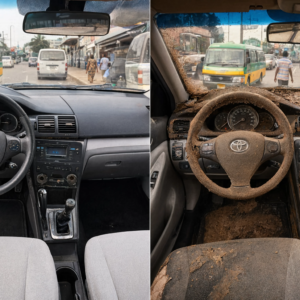
Here’s what “looks fine” actually means in the Nigerian used car market: a fresh paint job that hides rust and previous accident damage, a recently serviced engine that will start failing in three weeks, and a chassis that’s seen more Lagos Third Mainland Bridge potholes than any manufacturer intended.
What a proper pre-purchase inspection covers:
- Engine compression test (identifies wear and internal damage)
- Transmission fluid condition and gear engagement quality
- Brake pad and rotor thickness
- Suspension and steering component integrity
- Electrical system — AC, power windows, dashboard warning lights
- Undercarriage rust inspection (critical for Nigeria’s coastal humidity)
- Frame and chassis alignment check
- Tyre condition and wear patterns
- Fluid levels and leak indicators
- Body panel alignment (reveals previous collision repair)
The cost of skipping it:
Consider Emeka from Enugu, a reader who contacted CarWise.ng in 2024 after purchasing a 2014 Toyota Highlander for ₦8.5 million. It looked immaculate. The seller was friendly, the car started clean. Three weeks later, the automatic transmission started slipping. Total repair cost: ₦1.2 million. A ₦15,000 inspection would have caught it.
The rule: Never — under any circumstances — finalize a car purchase without an independent pre-purchase inspection. If a seller refuses to allow it, that refusal is the answer you need.
Mistake #2: Falling for “Direct Belgium” and Unrealistic Tokunbo Claims
If you’ve spent any time shopping for cars in Nigeria, you’ve heard it: “Direct Belgium, clean car, accident-free, one owner, low mileage.”
Let’s decode this for you.
“Direct Belgium” is Nigerian market slang that originally referred to cars imported from Belgium — but has evolved to mean “imported from Europe” generally, and in many cases, it’s simply used as a marketing phrase with no factual basis whatsoever. A “direct Belgium” car could have been:
- Salvaged and rebuilt in the Netherlands
- Flood-damaged in Germany and cosmetically restored
- A high-mileage taxi that was odometer-rolled back
- Crashed, repainted, and imported through Cotonou or Tincan port
Tokunbo vehicles (imported used cars) form the backbone of Nigeria’s used car market and there’s absolutely nothing wrong with buying one — as long as you verify what you’re actually getting.
How to verify a tokunbo vehicle’s actual history:
| Verification Method | What It Reveals | Cost Range |
|---|---|---|
| VIN check via Carfax or AutoCheck | Accident history, mileage, ownership | $25–$45 (approx. ₦40,000–₦70,000) |
| VIN check via NICIS (Nigeria Customs) | Import documentation legitimacy | Free–₦5,000 |
| Independent mechanical inspection | Mechanical condition, hidden damage | ₦10,000–₦30,000 |
| Paint thickness meter reading | Reveals repainted panels (accident history) | Part of PPI |
| VIN etching consistency check | Fraud/clone vehicle detection | Free (if you know where to look) |
The most important tool in your arsenal is the VIN — the 17-character Vehicle Identification Number stamped on the dashboard, engine bay, door frame, and chassis. Run it through Carfax.com or VINcheck.info before you even schedule a test drive. If the VIN doesn’t match across all four locations, walk away immediately.
A word on mileage:
A 2015 Toyota Camry with 40,000 miles sounds great. But if that car spent its life as a rideshare vehicle in Atlanta or a taxi in Brussels, “40,000 miles” means very little because the wear-and-tear is exponentially higher than a privately-owned vehicle with the same reading. This is why engine compression tests and transmission fluid analysis matter more than odometer readings alone.
🔗 Related Reading: How to Run a VIN Check on Any Car in Nigeria — CarWise.ng
Mistake #3: Letting Emotions Drive the Purchase Decision
You fall in love with a car. You’ve imagined yourself driving it. Your spouse loves the colour. Your friends think it’s sharp. And suddenly, every red flag you should be noticing gets rationalized away.
This is called emotional buying, and it is the auto industry’s oldest and most reliable trap — and car sellers in Nigeria are extraordinarily skilled at triggering it.
Watch out for these specific emotional triggers:
Artificial scarcity: “Two people are coming to see this car later today.” This is almost always false, designed entirely to make you act before you think.
Social proof pressure: “This exact model is selling fast — everyone wants this car.”
Identity appeal: The car makes you feel successful, established, or validated. You stop evaluating it as a machine and start evaluating it as a statement about yourself.
The anchor price trick: They quote ₦9 million. You negotiate to ₦7.5 million and feel like you won a victory. But the car was only ever worth ₦6 million.
The discipline framework:
Before you view any car, write down — on paper, not just in your head — your maximum budget, your non-negotiable requirements, and your three most important deal-breakers. When you’re standing in front of a car you like, refer to that list. Make yourself answer this question honestly: If this car fails my mechanic’s inspection, will I still want it? If the answer is “probably yes anyway,” you’re already in trouble.
Step back. Sleep on it. The right car will still be available tomorrow. And if it isn’t, the right next car will appear shortly after.
Mistake #4: Ignoring the Total Cost of Ownership — The Number That Actually Matters
Most first-time buyers in Nigeria focus entirely on the purchase price. This is a fundamental error.
The total cost of ownership (TCO) is the real number that determines whether a car is affordable for you — and it includes purchase price plus every naira you’ll spend on the vehicle over a defined period (typically 1–5 years).
Total Cost of Ownership breakdown for a typical Nigerian car buyer:
| Cost Category | Monthly Estimate (₦) | Annual Estimate (₦) |
|---|---|---|
| Fuel (Lagos daily commute, ~60km) | ₦60,000–₦120,000 | ₦720,000–₦1,440,000 |
| Routine maintenance (oil, filters) | ₦15,000–₦35,000 | ₦180,000–₦420,000 |
| Tyres (replacement cycle) | ₦8,000–₦20,000 | ₦96,000–₦240,000 |
| Insurance (third-party minimum) | ₦5,000–₦15,000 | ₦60,000–₦180,000 |
| Repairs (unexpected) | ₦20,000–₦80,000 | ₦240,000–₦960,000 |
| Vehicle registration/renewal | — | ₦15,000–₦50,000 |
| Parking and security | ₦5,000–₦30,000 | ₦60,000–₦360,000 |
| Total estimated annual TCO | — | ₦1,371,000–₦3,650,000 |
These figures are approximate and vary significantly by vehicle brand, age, engine size, and location.
The brand matters enormously in Nigeria’s market:
Toyota and Honda vehicles consistently rank as the most cost-effective to maintain in Nigeria because of the abundance of genuine spare parts, the large mechanic community trained on these platforms, and the brand’s inherent reliability engineering.
Compare that to some European luxury vehicles — your BMW 5-Series or Mercedes-Benz E-Class — where a single sensor replacement can cost more than three months of Toyota maintenance. That’s not a knock on those brands; it’s simply the Nigerian market reality.
Practical rule of thumb: Your annual car running costs should not exceed 30–40% of your annual take-home income. If they do, the car is too expensive for you — regardless of how manageable the purchase price seemed.
Mistake #5: Not Verifying Vehicle Documentation — The Legal Minefield
Buying a car with problematic paperwork in Nigeria isn’t just financially painful — it can result in the vehicle being seized, fines, legal disputes, and an inability to register the car in your name.
Documents you must verify before purchase:
1. Proof of Ownership (Custom Paper / Vehicle License)
This is the primary document establishing the seller’s right to sell the vehicle. For tokunbo vehicles, this includes the original Customs Duty Clearance Certificate (Form M) from the Nigeria Customs Service.
2. Vehicle Particulars
The vehicle registration document must match the VIN, plate number, and vehicle description exactly. Any discrepancy is a serious red flag.
3. Roadworthiness Certificate
Issued by the Vehicle Inspection Officers (VIO) in each state. Its validity period and the conditions it was issued under matter.
4. Insurance Certificate
Even third-party insurance documentation helps establish a vehicle’s legitimate history.
5. Police Report (if applicable)
For vehicles that have been involved in accidents or reported incidents.
6. Seller’s Valid ID
Match the seller’s identity against the ownership documents. If the name doesn’t match and they claim to be selling “on behalf of” the owner, escalate your scrutiny significantly.
Red flags that should stop a purchase cold:
- Missing or photocopied customs papers on a tokunbo vehicle
- VIN on documents doesn’t match VIN on the vehicle
- Seller is unusually resistant to document verification
- Registration papers from a state the seller has no obvious connection to
- Significantly discounted price with vague explanations (“owner is travelling,” “urgent sale”)
The FRSC and State Motor Licensing Authority can help verify genuine vehicle registration. Don’t skip this step.
Mistake #6: Buying Without a Clear Budget — Or Completely Ignoring It
This mistake sounds basic, but it catches more buyers than you’d expect — especially when financing is involved.
Scenario A — No budget: The buyer goes car shopping “to see what’s out there.” They find a car that costs 40% more than they can reasonably afford, and they either stretch dangerously or walk away dejected.
Scenario B — Ignored budget: The buyer has a budget but convinces themselves this particular car is worth the stretch. They deplete their emergency fund making up the difference, and the first repair bill creates a genuine financial crisis.
How to set a car buying budget in Nigeria:
- Determine your all-cash maximum: The absolute most you can spend without destabilizing your finances or depleting savings below three months of expenses.
- Subtract a repair buffer: Reserve 10–15% of the purchase price for immediate post-purchase repairs and maintenance. On a ₦4 million car, that’s ₦400,000–₦600,000 you should already have set aside.
- Set your target price: Aim to spend 70–80% of your maximum, giving yourself negotiating room.
- If using auto financing: Ensure your monthly repayment does not exceed 15–20% of your monthly net income. Check current rates from institutions like First Bank AutoLoan, Access Bank vehicle finance, or LAPO for accessible options.
The danger of emotional budget-breaking: When you exceed your budget by ₦1 million because you “fell in love” with the car, that ₦1 million doesn’t just disappear — it compounds. It becomes an opportunity cost, a potential debt burden, and a stress point that affects your relationship with the vehicle from day one.
Buy within your means. The right car for your budget always exists.
Mistake #7: Trusting the Wrong People — Understanding Nigeria’s Used Car Sales Landscape
Nigeria’s used car market is vibrant, diverse, and unfortunately — partially populated by people whose primary interest is not your satisfaction.
Let’s talk about who you’re likely to encounter:
Legitimate independent dealers run established car lots, maintain reputations, and often provide limited warranties or return policies. They’re your safest option in the dealer category.
Market association traders (like those at Trade Fair Complex in Lagos, or Kasuwan Mota in Kano) operate in established ecosystems with informal accountability structures. Not without risk, but generally more traceable.
Private sellers can be excellent or problematic depending on their honesty. Always verify documentation independently.
Cotonou-linked traders operate a significant part of Nigeria’s tokunbo supply chain. Many are entirely legitimate — but the Cotonou market also handles significant volumes of accident-damaged, flood-damaged, and odometer-manipulated vehicles. Your due diligence must be highest when sourcing through this channel.
The “Oga-refer-me” situation: Someone you trust refers you to their “guy” for a car deal. Your trust in Person A transfers to Person B — whom you actually know nothing about. This is how buyers get burned by people they never would have approached independently.
Protective practices:
- Never let a middleman hold your money “while the deal is arranged”
- Always conduct your own independent verification — even when referred
- Use escrow or bank-certified instruments for large transactions
- Get every agreement in writing — no verbal assurances count in a dispute
- If a deal is being rushed, treat the urgency itself as a red flag
Online platforms to use (carefully):
Jiji.ng, Cars45.com, and AutoJara.com provide reasonable starting points for price discovery. Cars45 in particular offers an inspection service that provides an independent assessment, which is valuable. However, use these platforms for research and leads — never skip your own independent verification.
Mistake #8: Ignoring Fuel Economy in the Era of ₦1,000+ Per Litre Petrol
With petrol prices in Nigeria now hovering around ₦1,000–₦1,300 per litre as of early 2026 — a stark reality since the subsidy removal — fuel economy is no longer a “nice to have” consideration. It’s a core financial survival factor.
A car that returns 8 litres per 100km versus one returning 12 litres per 100km can translate to over ₦400,000 in additional annual fuel cost for a Lagos driver covering 200km daily — just from that single efficiency difference.
Fuel economy comparison: Popular Nigeria market vehicles
| Vehicle | Engine | Approx. Fuel Economy (City) | Annual Fuel Cost (200km/day) |
|---|---|---|---|
| Toyota Corolla (2015–2019) | 1.8L | 9–11L/100km | ₦2.8M–₦3.4M |
| Honda Civic (2016–2021) | 1.5T | 8–10L/100km | ₦2.5M–₦3.1M |
| Toyota RAV4 (2015–2019) | 2.5L | 11–13L/100km | ₦3.4M–₦4.0M |
| Toyota Camry (2015–2018) | 2.5L | 10–12L/100km | ₦3.1M–₦3.7M |
| Toyota Hilux (2018–2022) | 2.8D | 9–12L/100km | ₦2.8M–₦3.7M |
| Ford Explorer (2016–2019) | 3.5L | 14–17L/100km | ₦4.3M–₦5.3M |
| Lexus RX 350 (2016–2020) | 3.5L | 13–16L/100km | ₦4.0M–₦5.0M |
Estimates based on typical Nigerian driving conditions. ₦1,150/litre average fuel price used.
Practical advice:
If you’re primarily a Lagos-Abuja highway driver, a larger engine vehicle is more manageable because highway driving is inherently more fuel-efficient. If you’re primarily navigating Lagos, Kano, or Onitsha city traffic — where you’ll spend significant time idling and stop-start driving — prioritize smaller, more efficient engines ruthlessly.
Hybrid vehicles (Toyota Camry Hybrid, Toyota Corolla Hybrid) are increasingly appearing in the Nigerian tokunbo market and deserve serious consideration in 2026 given fuel prices. Their maintenance is more specialized but fuel savings can be dramatic.
Mistake #9: Skipping the Test Drive — Or Doing It Completely Wrong
The test drive is not a formality. It is your primary diagnostic tool as a non-technical buyer, and most first-time buyers conduct it entirely incorrectly.
What most buyers do: Drive around the block for five minutes, confirm the car moves and stops, decide it “feels good,” and declare the test drive complete.
What you should actually do:
Before you start the engine:
- Check all fluid levels with the engine cold
- Look for fresh oil drips or coolant residue under the car
- Check tyre pressure visually and by feel
During cold start:
- Let the car cold-start before you get in — listen for unusual noises, excessive smoke, rough idle
- White smoke on startup in hot Nigerian weather can be normal; persistent white or blue smoke is not
The actual drive — what to test:
- Acceleration: Does it pull smoothly and evenly from low speeds?
- Transmission shifts: On an automatic — smooth progression through all gears? Hesitation, jerking, or hunting between gears are transmission warning signs
- Braking: At 60km/h on a clear road, apply brakes firmly. Does the car pull left or right? Any vibration? Any grinding sound?
- Steering: At highway speed, does the steering feel tight and responsive, or wandering and loose?
- Cornering: Body roll is normal; excessive lean, knocking, or clunking sounds through corners indicate suspension issues
- Air conditioning: Run it at maximum for 10 minutes in Nigerian heat. Does it cool properly? Any odd smells or condensation issues?
- Electrical systems: Test every single switch, window, mirror control, and dashboard function
- Engine under load: Climb a bridge or hill if possible — how does the engine respond under load?
The highway test:
If logistics permit, take the car on a stretch of expressway. Highway driving reveals vibrations, steering wander, and transmission behavior that city driving masks.
The parking/reversing test:
Reverse, park, and maneuver in a tight space. Power steering quality, camera or sensor function, and transmission reverse engagement all reveal themselves here.
A thorough test drive takes 30–45 minutes minimum. If the seller won’t allow this, add it to your growing list of reasons to walk away.
Mistake #10: Neglecting Post-Purchase Registration and Insurance
You’ve bought the car. You’re excited. And now the temptation is enormous to just start driving it — sorting out paperwork “when you have time.”
This is a costly mistake in both money and legal exposure.
In Nigeria, driving without proper documentation exposes you to:
- FRSC and VIO checkpoints resulting in vehicle seizure or fines
- Personal financial liability for accidents with no insurance protection
- Inability to legally sell the vehicle later
- Complications if the vehicle is involved in any law enforcement matter
The post-purchase documentation checklist:
| Document | Issuing Authority | Validity | Approximate Cost |
|---|---|---|---|
| Change of Ownership | State Motor Licensing Authority | One-time | ₦5,000–₦15,000 |
| New Vehicle License | State MVAA | 1 year | ₦10,000–₦30,000 |
| Roadworthiness Certificate | VIO (state-based) | 1 year | ₦5,000–₦20,000 |
| Third-Party Insurance | Licensed insurer | 1 year | ₦15,000–₦50,000 |
| Comprehensive Insurance | Licensed insurer | 1 year | 3–5% of vehicle value |
| Hackney Permit (if applicable) | State | 1 year | Varies by state |
On insurance: Third-party insurance is the legal minimum in Nigeria, but for any car worth more than ₦3 million, comprehensive insurance is strongly recommended. The additional premium is significantly lower than a single repair bill from an accident where the at-fault party cannot pay. Insurers like AXA Mansard, Leadway Assurance, and Cornerstone Insurance offer competitive vehicle policies.
Complete your paperwork within 2 weeks of purchase, without exception.
Bonus Section: The Smart Nigerian Car Buyer’s Pre-Purchase Checklist
Use this checklist on every vehicle you seriously consider:
📋 Before You Even See the Car
- Run the VIN through Carfax or VINcheck.info
- Verify the seller’s identity against ownership documents
- Research the model’s common problems and known issues in Nigeria
- Confirm the asking price against market rate (Cars45, Jiji comparables)
- Set your absolute maximum budget in writing
🔍 At First Viewing
- Check that VIN matches across dashboard, door frame, engine bay, and chassis
- Inspect all body panels for paint thickness inconsistency (repaint indicator)
- Check panel gap consistency (indicates previous collision repair)
- Inspect undercarriage for rust, accident damage, welding
- Check tyre brand, age code (DOT date), and wear pattern
- Inspect interior — carpet, seats, and headliner for water damage signs
🔧 During Mechanic Inspection
- Engine compression test completed
- Transmission fluid analyzed
- Brake pads and rotors measured
- Suspension checked on lift
- Electrical systems fully tested
- AC system performance confirmed
- Full fluid check and leak assessment
🚗 During Test Drive
- Cold start observed
- Acceleration and transmission smooth
- Braking straight and vibration-free
- Steering tight and responsive
- No abnormal sounds through corners or bumps
- All electricals confirmed working
- AC cooling confirmed
📄 Documentation Verification
- Customs paper/Form M (for tokunbo)
- Vehicle particulars match VIN
- Seller identity confirmed against documents
- Payment via traceable bank transfer only
- Written agreement of sale signed
Tokunbo vs. Brand-New vs. Nigerian-Used: Which Is Right for You?
| Factor | Brand-New | Tokunbo (Imported Used) | Nigerian-Used |
|---|---|---|---|
| Purchase Price | Highest | Medium–High | Lowest |
| Condition Certainty | Very High | Medium (needs verification) | Variable |
| Warranty Available | Yes (1–3 years) | Rarely | No |
| Documentation Risk | Minimal | Medium | Higher |
| Immediate Repair Risk | Very Low | Medium | Higher |
| Depreciation Hit | High (immediate) | Already absorbed | Already absorbed |
| Parts Availability | Good (new models) | Good (popular models) | Good (common models) |
| Best For | Long-term ownership priority | Balance of value and condition | Tight budget, short-term need |
| Financing Options | Widely available | Available | Limited |
| Resale Value | Good | Good | Lower |
Our recommendation for most first-time Nigerian buyers: A well-inspected tokunbo vehicle from a reputable dealer — especially Toyota or Honda — in the 3–7 year age range offers the best balance of affordability, reliability, and parts availability for Nigerian conditions.
Frequently Asked Questions
1. How much should a first-time car buyer budget for a reliable car in Nigeria in 2026?
For a genuinely reliable first vehicle in Nigeria in 2026, budget a minimum of ₦3.5 million to ₦6 million for a tokunbo Toyota Corolla, Honda Civic, or similar reliable sedan in good mechanical condition. Below ₦2.5 million, you’re increasingly likely to encounter vehicles that need significant mechanical investment immediately after purchase. Factor in 10–15% of your purchase price as a maintenance reserve.
2. Is it safe to buy a car on Jiji or other Nigerian online platforms?
Yes — with the right precautions. Platforms like Jiji.ng and Cars45.com are legitimate starting points for price research and finding leads. However, never pay any money without physically inspecting the vehicle, independently verifying documentation, and conducting a pre-purchase mechanical inspection. Never use cash for large transactions; use bank transfers that create a paper trail. Be especially cautious of deals that seem significantly below market price.
3. What is the best used car to buy in Nigeria for durability and low maintenance cost?
In 2026, the Toyota Corolla (2014–2020), Toyota Camry (2015–2019), and Honda Accord (2013–2017) remain the gold standard for durability and maintenance affordability in Nigeria. Spare parts are widely available, mechanics are familiar with them, and their engineering is proven robust under Nigerian road conditions. For those needing SUV capability, the Toyota RAV4 and Toyota Highlander offer similar reliability advantages.
4. What documents must a seller provide when selling a car in Nigeria?
A legitimate seller must provide: vehicle particulars (registration document with matching VIN), proof of ownership (original customs duty clearance for tokunbo vehicles or a clean title), a valid roadworthiness certificate, and their own valid government-issued ID that matches the ownership documents. Any sale without these complete documents should be declined.
5. Can I negotiate car prices in Nigeria, and by how much?
Absolutely — negotiation is expected and normal in Nigeria’s car market. On private sales, you can typically negotiate 10–20% below the asking price for vehicles that have been on the market for a while. On dealer lots, 5–15% is more realistic. Use the mechanic’s inspection report strategically: if issues are found, quantify the repair cost and use that as a concrete negotiating tool. Any seller who refuses all negotiation on a used vehicle deserves scrutiny.
6. Should I buy a car with a Nigerian salvage title or that has been involved in an accident?
This requires careful judgment. Minor fender-bender repairs on a vehicle with otherwise sound mechanicals and structure are not necessarily disqualifying — if the repair was properly done. However, vehicles with structural/frame damage, flood history, or severe collision history carry risks that often outweigh their lower price. If you’re a first-time buyer, avoid previously salvaged vehicles entirely. The complexity of evaluating them properly exceeds most beginners’ ability to assess.
7. How do I verify if a used car has genuine low mileage in Nigeria?
You cannot rely on the odometer reading alone, as odometer rollback is common in both the Nigerian and international used car markets. Instead: run a VIN check through Carfax or AutoCheck for service history records; compare the interior wear (steering wheel, pedals, driver’s seat bolster) against the claimed mileage — these elements wear proportionally to actual use; conduct an engine compression test; and examine the timing belt or chain service history. If claimed mileage is 50,000km but the pedal rubber is worn through, trust the pedals.
8. What is the most important thing to check when buying a tokunbo car in Nigeria?
The single most important check is verifying the VIN across all four locations (dashboard, engine bay, door frame, chassis) and running that VIN through an international history database. After that, an independent pre-purchase inspection by a qualified mechanic is non-negotiable. These two steps together will reveal the vast majority of significant problems that sellers may be concealing, whether intentionally or unknowingly.
Conclusion: Your Path to a Smart Car Purchase Starts Today
Here’s the truth that every experienced car buyer in Nigeria will confirm: there are no magical shortcuts, no insider secrets, and no luck-based approaches to buying a good used car. There is only preparation, due diligence, and the discipline to walk away when something doesn’t feel right.
You’ve just read everything you need to join the minority of first-time buyers who come out of their first car purchase ahead — with a reliable vehicle, proper paperwork, and financial stability intact.
Your immediate action steps:
- Define your budget today — write it down with your maintenance reserve included
- Research your target vehicle — learn its common problems and typical market price in Nigeria
- Find an independent mechanic you trust before you start car shopping, not after
- Set your non-negotiables — document requirements, inspection requirements, deal-breakers
- Start your search using reputable platforms and apply everything in this guide before you spend a single naira
The car you deserve — reliable, properly documented, and genuinely worth what you pay — is absolutely available in Nigeria’s 2026 market. You just have to be smarter than the sellers who prefer you aren’t.
CarWise.ng is here every step of the way.
💡 Was this guide helpful? Share it with someone who’s about to buy their first car in Nigeria — you might save them millions of naira and months of headaches. Have a question we didn’t cover? Drop it in the comments below and our team will respond.