How to Buy a Reliable Used Car Under ₦5 Million in Nigeria Without Getting Scammed (2026 Complete Guide)
The ₦5 Million Question — Can You Actually Buy a Reliable Car in Nigeria?
Let’s be honest with each other for a moment.
You’ve probably heard the horror stories. A friend buys what looks like a clean Toyota Camry at Berger market for ₦3.8 million, drives it home, and within three months he’s spent another ₦900,000 on repairs he never saw coming. Or worse — someone pays for a car online, transfers the money, and the “seller” disappears completely.
These stories are real. They happen every single week across Lagos, Abuja, Port Harcourt, and everywhere in between.
But here’s the other truth: Nigerians successfully buy reliable used cars every day. People drive tokunbo vehicles for five, eight, even ten years without drama — and they do it on budgets well under ₦5 million. The difference between them and the horror-story buyers isn’t luck. It’s knowledge.
That’s exactly what this guide is for.
By the time you finish reading this, you’ll know how to walk into any car market, any online listing, or any dealer’s yard in Nigeria with the confidence of someone who cannot be easily fooled. You’ll know what to look for, what questions to ask, what documents to demand, and when to walk away without looking back.
This isn’t a generic car-buying guide copied from a Western website. Every single recommendation here is built for Nigerian roads, Nigerian weather, Nigerian fuel realities, and the actual Nigerian used car market in 2026.
Let’s get into it.
Section 1: Why the Used Car Market in Nigeria Is Both an Opportunity and a Minefield
The Size and Structure of Nigeria’s Used Car Market
Nigeria’s used car market is one of the largest on the African continent. According to data from the Nigeria Customs Service and industry estimates, Nigeria imports hundreds of thousands of used vehicles annually, with the majority arriving through the ports of Lagos (Apapa and Tin Can Island) and Cotonou, Benin Republic — a longstanding informal import gateway.
This massive market creates genuine opportunity. Because supply is high and competition among sellers is fierce, a knowledgeable buyer can find excellent value. But that same size and informality also creates the perfect environment for fraud, misrepresentation, and outright theft.
To navigate it well, you first need to understand the three main categories of vehicles you’ll encounter:
Tokunbo, Nigerian-Used, and Salvage: Know What You’re Actually Buying
Tokunbo Vehicles
“Tokunbo” is Yoruba for “from overseas” — and in Nigerian automotive culture, it refers to used vehicles imported from the United States, Canada, Europe, or Asia. These cars were previously owned and driven abroad before being shipped to Nigeria. A genuine tokunbo in good condition is often your best bet for value and reliability.
Nigerian-Used Vehicles
These are cars that were either purchased new in Nigeria (by corporate bodies, embassies, or wealthy individuals) or were tokunbo vehicles that have since changed hands within Nigeria. Their quality varies enormously — a well-maintained Nigerian-used car from a careful owner can be a gem; one from a vehicle-for-hire operation can be completely destroyed inside.
Salvage or Rebuilt Vehicles
This is where things get dangerous. Salvage vehicles are cars that were involved in serious accidents or declared total losses abroad, then shipped to Nigeria, repaired (sometimes shoddily), and resold as clean tokunbo. They often look beautiful on the outside but have compromised structural integrity that can cost you your life on a bad Nigerian road. Spotting these is a core skill this guide will teach you.
Common Scams Targeting Nigerian Car Buyers in 2026
Before we go further, let’s name the scams so you can recognize them immediately:
- The Clone Car Scam: A seller presents a stolen vehicle with fake or cloned documents that match a legitimate car’s registration. Everything looks real until you try to register the car in your name.
- The Accident Concealment Scam: Sellers use fresh paint, body filler (popularly called “putty”), and aggressive cleaning to hide accident damage, rust, and flood history.
- The Online Ghost Listing: A car is advertised online at an impossibly attractive price. When you show interest, you’re asked for a deposit to “hold” the car. You pay. The seller vanishes.
- The Fake Bank Alert: You receive what appears to be a bank credit alert on your phone after paying. The alert is a screenshot or fake SMS. The money never arrived in your account.
- The Temporary Fix Scam: A car with serious mechanical problems is temporarily fixed just enough to pass a test drive, then sold. Within weeks, everything falls apart.
- The Omonile (Land Grabber) Car: A vehicle illegally sold by someone who doesn’t own it — possibly a family member, employee, or someone who found or stole the vehicle.
Knowing these scams exist is the first layer of protection. The inspection skills and documentation verification steps in this guide are the second and third layers.
Section 2: Setting Your Budget the Smart Way
The Real Cost of Owning a Used Car in Nigeria (Beyond the Sticker Price)
This is the part most buyers skip — and it’s exactly why they end up in financial trouble three months after purchase.
When you say you have ₦5 million for a car, that ₦5 million cannot all go toward the purchase price. Smart buyers treat the car’s price as just one component of a larger budget.
Here’s a realistic budget framework for a ₦5 million total vehicle budget:
| Cost Component | Realistic Range | Notes |
|---|---|---|
| Car Purchase Price | ₦3,500,000 – ₦4,200,000 | Leaves room for other costs |
| Pre-Purchase Inspection | ₦10,000 – ₦30,000 | Professional mechanic fee |
| Initial Repairs/Servicing | ₦50,000 – ₦300,000 | Almost every used car needs something |
| Vehicle Registration/Change of Ownership | ₦30,000 – ₦80,000 | Varies by state |
| Insurance (Third Party minimum) | ₦15,000 – ₦50,000 | Annual; comprehensive costs more |
| Tires (if needed) | ₦80,000 – ₦200,000 | 4 decent tires for a saloon car |
| Emergency/Buffer Fund | ₦200,000 – ₦400,000 | You will need this |
Notice that “emergency fund” at the bottom. It’s not optional. Every used car — even a good one — will need unexpected attention in the first few months. Buyers who spend every naira on the purchase price and have nothing left are the ones who end up stranded on Third Mainland Bridge at 9 PM.
What ₦5 Million Can Realistically Get You in 2026
The Nigerian used car market fluctuates significantly based on exchange rates (the Naira-to-Dollar rate directly affects tokunbo prices since most are priced in dollars at point of import), fuel costs, and seasonal demand. As of 2026, here’s a realistic picture:
| Budget Range | What to Expect |
|---|---|
| ₦1.5M – ₦2.5M | Older generation Camry (2002–2006), Corolla (2003–2007), Sentra; high mileage likely |
| ₦2.5M – ₦3.5M | Corolla (2008–2012), Honda Civic (2008–2011), Hyundai Elantra (2011–2014) |
| ₦3.5M – ₦4.5M | Camry (2010–2014), Honda Accord (2008–2012), Kia Optima; better condition likely |
| ₦4.5M – ₦5M | Camry (2013–2016), Prado/4Runner entry range, Ford Explorer older gen |
Note: Prices vary by location, seller, and condition. Always research current market prices on platforms like Cars45.com, Jiji.ng, and CarWise.ng before entering any negotiation.
Section 3: Choosing the Right Car for Nigerian Roads
Best Used Cars to Buy in Nigeria Under ₦5 Million (2026 Recommendations)
Not all cars are created equal — and not all cars designed for American or European roads survive Nigerian conditions gracefully. The following vehicles have proven track records of reliability, parts availability, and durability on Nigerian roads:
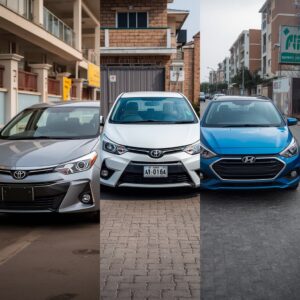
🥇 Toyota Corolla (2008–2014)
The undisputed champion of reliability in the Nigerian market. Parts are everywhere, mechanics know it cold, fuel economy is excellent, and it handles rough roads reasonably well. If you want the safest bet under ₦5 million, this is it.
🥈 Toyota Camry (2010–2014)
More spacious and comfortable than the Corolla, still very reliable. The 2010–2011 generation (SE, LE trims) is particularly good value. Parts availability is excellent.
🥉 Honda Accord (2008–2012)
Nigerians love the Accord, and for good reason — it’s spacious, comfortable, and reliable when properly maintained. The main caution: Honda electronics can be expensive to fix if they develop faults.
Also Worth Considering:
- Hyundai Elantra (2011–2016): Underrated, increasingly popular, good fuel economy, affordable parts
- Toyota Highlander (2004–2010): For those who need ground clearance without full SUV budget
- Honda CR-V (2007–2011): Good SUV option with reasonable maintenance costs
Cars to Approach With Caution Under ₦5M:
- European brands (BMW, Mercedes, Volkswagen) — parts are expensive and specialized mechanics charge premium rates
- American trucks and large SUVs — fuel consumption will drain you at ₦1,000+ per litre
- Any car with CVT transmission at this price point — CVT repairs can be brutally expensive
Parts Availability and Maintenance Costs by Brand
| Brand | Parts Availability | Avg. Annual Maintenance | Mechanic Familiarity |
|---|---|---|---|
| Toyota | Excellent (nationwide) | ₦150,000 – ₦350,000 | Very High |
| Honda | Very Good | ₦180,000 – ₦400,000 | High |
| Hyundai/Kia | Good (improving) | ₦160,000 – ₦380,000 | Moderate–High |
| Ford | Moderate | ₦250,000 – ₦600,000 | Moderate |
| Nissan | Good | ₦200,000 – ₦450,000 | High |
| BMW/Mercedes | Poor–Moderate | ₦500,000 – ₦1,500,000+ | Low–Moderate |
Section 4: Where to Buy — Trusted Sources vs. Danger Zones
Your Buying Options in Nigeria
Option 1: Established Certified Dealers
Dealers like Cars45, Autochek, Cheki-affiliated outlets, and established physical dealerships with proper addresses and track records offer the highest purchase security. You’ll typically pay a premium — sometimes 10–20% above open market prices — but you get inspection reports, some form of warranty or return policy, and legal protection. For buyers who are less confident about self-inspection, this premium is often worth every naira.
Option 2: Open Car Markets
Berger (Lagos), Wuse Market (Abuja), Rumuola (Port Harcourt), Aba Main Market — these are the heartbeat of Nigeria’s used car trade. Prices are negotiable and selection is huge. The risk is also much higher. Operate here only if you’re bringing a trusted, experienced mechanic for inspection.
Option 3: Online Platforms (Jiji.ng, Cars45, Autochek, CarWise.ng listings)
Online listings give you the widest selection and the ability to compare prices across sellers before leaving your house. The risks include fraudulent listings, misrepresented vehicle conditions, and payment scams. Always insist on physically inspecting any car before payment — no exceptions.
Option 4: Private Sellers (Word of Mouth)
Buying from someone you know, or someone vouched for by a trusted mutual contact, can yield excellent deals. The car’s history is often traceable, and there’s social accountability. Still run a full inspection regardless of how well you know the person.
Red Flags That Should Make You Walk Away Immediately
Stop. Turn around. Leave — no matter what the seller says — if you encounter any of these:
- ❌ Seller refuses to allow an independent mechanic inspection
- ❌ Price is significantly below market rate with no clear explanation
- ❌ Seller is extremely rushed (“Another buyer is coming in 30 minutes”)
- ❌ Documents are incomplete, photocopied, or the seller claims originals are “at home”
- ❌ VIN on the dashboard doesn’t match VIN on the door sticker or engine bay
- ❌ Fresh paint on selective body panels with no accident history explanation
- ❌ Seller insists on cash only, especially large amounts
- ❌ Meeting location keeps changing or seller won’t show you where the car normally lives
- ❌ Car has no customs duty clearance papers (for a claimed tokunbo)
Section 5: The Complete Used Car Inspection Checklist
This is the section that could save you millions of naira. Read it. Print it. Take it with you.
Ideally, you should bring a trusted, independent mechanic to any serious inspection — someone who works for you, not the seller. Expect to pay between ₦10,000 and ₦30,000 for a professional pre-purchase inspection. It is the best money you’ll spend in this entire process.
Here’s what to check, systematically:
Step 1: Before You Even Open the Door — Exterior Inspection
Body Panels and Paint:
Walk around the entire car and look at each panel from multiple angles. Crouch down and look along the side of the car toward the light. You’re looking for:
- Uneven panel gaps: Doors, hood, and trunk that don’t align evenly suggest the car has been in a significant collision and repaired. On a good car, gaps should be uniform and consistent.
- Paint colour variations: Get close to adjacent panels and compare. A repainted panel will often have a slightly different shade, texture, or sheen — especially visible in direct sunlight. Run your hand along panels; repainted sections often feel slightly rougher.
- Bubbling or rust spots: Any rust bubbling under paint, especially around wheel arches, door sills, and the lower rear quarters, is a warning sign. Some surface rust on older cars is normal, but bubbling means active rust underneath.
- Body filler (putty): Use a small magnet. Genuine metal will hold the magnet; body filler won’t. Run the magnet along panels you suspect. A panel where the magnet holds less strongly or falls off has been filled.
Glass:
Check all windows for cracks, chips, and stress lines. A cracked windscreen isn’t necessarily a dealbreaker (they can be replaced for ₦30,000–₦80,000 depending on the model), but factor it into your price negotiation. Also check that all windows roll up and down smoothly.
Tires:
Check tread depth — insert a ₦50 coin into the groove. If the coin is barely covered, the tires need replacing soon. Check for uneven wear patterns: wear on just one edge of a tire usually indicates alignment or suspension problems. Check that all four tires are the same size and brand if possible.
Lights:
Turn on all lights — headlights (high and low beam), indicators, brake lights, reverse lights, hazard lights. Check that none are cracked, waterlogged, or mismatched.
Step 2: Open the Hood — Engine Bay Inspection
The engine bay tells you more about a car’s history than almost anything else. Take your time here.
Oil Check:
Pull the dipstick, wipe it, reinsert, and pull again. Look at the oil:
- Good oil: Light amber to dark brown, clear
- Warning signs: Black, thick, sludgy oil (neglected maintenance); milky or frothy oil (coolant leak into engine — potentially very serious); oil that smells burnt
Coolant:
Check the coolant reservoir. It should be between MIN and MAX. The coolant should be green, blue, or orange — never brown or rusty, which indicates contamination and possible mixing with water (very common in Nigeria, very bad for the engine).
Battery:
Check for corrosion (white or blue powdery buildup) on battery terminals. Ask the seller when the battery was last replaced. A battery over three years old in Nigerian heat and electrical-load conditions is typically near end of life.
Belts and Hoses:
Squeeze the rubber hoses — they should feel firm and supple, not cracked, hard, or mushy. Check timing belts or serpentine belts for cracks or fraying. A snapped timing belt on many engines can cause catastrophic damage costing ₦300,000 or more.
Fluid Levels:
Check brake fluid, power steering fluid, and transmission fluid (if accessible). Low fluid levels suggest either leaks or neglect.
Signs of Leaks:
Look at the engine bay floor (below the engine) and the ground where the car is parked. Fresh oil stains, coolant puddles, or transmission fluid leaks on the ground are serious concerns.
Engine Start — Listen Carefully:
Start the engine cold if possible (not after the seller has already warmed it up — cold starts reveal more). Listen for:
- Smooth, even idle: Good
- Knocking or ticking sounds: Could be minor (low oil pressure) or major (engine wear)
- Rattling on startup that disappears: Might be normal, might indicate timing chain wear
- Excessive smoke on startup: Blue smoke = oil burning; white smoke = coolant burning; black smoke = fuel mixture issues
Step 3: Interior Inspection
Step inside and be methodical:
Dashboard Warning Lights:
Turn the key to the “on” position before starting the engine. All warning lights should illuminate briefly (this is a self-check). Watch for any that stay on after starting — especially the check engine light, oil pressure light, or battery light. A seller who immediately starts the car before you can see the dashboard warning lights is hiding something.
Air Conditioning:
Turn the AC on maximum. In Nigeria, a non-functional AC is almost a dealbreaker. The car should start blowing cold air within 30 seconds to 2 minutes. Check that all vents work. A regas typically costs ₦15,000–₦30,000, but if the compressor or condenser is faulty, you’re looking at ₦80,000–₦250,000.
All Electrical Functions:
- Power windows (all four, both up and down)
- Central locking
- Side mirrors (adjustment and folding if applicable)
- Infotainment/radio
- Reverse camera if equipped
- Interior lights
Upholstery and Cabin:
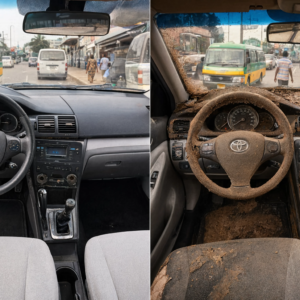
Check seat fabric or leather for tears, burns, and staining. Pull back floor mats and check the floor carpet — particularly the front floor area and trunk. Wet or stained carpet can indicate water damage or a flood vehicle (extremely common in Nigeria, where vehicles are sometimes caught in flash floods or improperly stored).
Smell Test:
Trust your nose. A musty or mouldy smell suggests water ingress. A burning smell means electrical or mechanical issues. A strong air freshener smell might be masking one of these.
Step 4: Under-the-Car Inspection
If you’re at a market, crouch down (or get your mechanic to do this). Look under the car for:
- Rust on the chassis/frame: Surface rust can be treated; deep structural rust is a safety hazard
- Exhaust system: Check for holes, patches, and excessive rust. A broken exhaust isn’t catastrophic but will cost ₦20,000–₦80,000 to fix
- Oil or fluid leaks: Fresh drips on the undercarriage or ground directly below
- Accident damage: Bent or straightened frame rails are a sign of serious accident history. Once a frame is bent and straightened, it’s never quite the same
- CV joint boots: The rubber boots covering the CV joints (inner and outer) should be intact. Torn boots mean dirt has entered and the joint will soon fail — replacement costs ₦20,000–₦60,000 per side
Step 5: The Test Drive — Don’t Skip This
Never buy a car you haven’t driven. A 20-minute test drive on real Nigerian roads tells you things no inspection can.
What to do during the test drive:
- Drive at different speeds: Start slow, then find a stretch where you can reach 80–100 km/h safely
- Brake firmly: The car should stop in a straight line without pulling to one side. Pulling indicates brake or alignment issues. A pulsating brake pedal suggests warped rotors
- Let go of the steering wheel briefly on a straight road: The car should track straight. If it pulls consistently, alignment or suspension is off
- Test the transmission: Automatics should shift smoothly without jerking, hesitation, or “hunting” (shifting up and down repeatedly). Manual gearboxes should shift cleanly without grinding
- Windows down, radio off: Listen for knocking, rattling, clunking over bumps, or whining sounds at speed
- Park on a slope: Make sure the handbrake holds
- Check the AC again during driving: It should maintain cool air even when the car works harder
Section 6: Vehicle History and Documentation Verification
Essential Documents Every Legitimate Car Sale Must Include
In Nigeria, a legitimate used car sale must come with specific paperwork. Demand every single one of these before you hand over any money:
| Document | What It Proves | What to Watch For |
|---|---|---|
| Vehicle Registration Certificate (VRC) | Car is legally registered in Nigeria | Name, VIN, and plate number must match |
| Customs Duty Clearance (Form M/SGD) | Duty was paid; car legally imported | Request original, not photocopy |
| Certificate of Insurance | Car is insured | Check expiry date |
| Vehicle Licence (Road Worthiness) | Annual regulatory compliance | FRSC-issued; check the seal |
| Proof of Ownership / Bill of Sale | Seller legally owns the car | Name must match VRC |
| Tax Clearance (in some states) | Vehicle taxes paid | Lagos, Abuja often require this |
If a seller cannot produce originals of the registration certificate and customs duty papers, do not complete the purchase. These two documents are non-negotiable.
VIN Verification — Your Most Important Check
The Vehicle Identification Number (VIN) is a 17-character code unique to every vehicle. In Nigeria, VIN fraud (cloning) is an active and sophisticated problem.
Find the VIN in these locations and confirm they ALL match:
- Dashboard (visible through the windscreen, driver’s side)
- Driver’s door jamb sticker
- Under the hood (stamped on the engine bay firewall)
- On the registration documents
If any of these don’t match, you are almost certainly looking at a stolen, cloned, or fraudulently documented vehicle. Walk away immediately.
For tokunbo vehicles, you can run a free or low-cost VIN check through resources like:
- CARFAX (for US-imported vehicles): carfax.com
- AutoCheck (for North American vehicles): experian.com/autocheck
- Vehicle History (for European imports): vehiclehistory.com
These reports will reveal accident history, odometer readings, title status (salvage, flood, clean), and previous ownership in the source country. A VIN history check for a US-imported vehicle typically costs $10–$30 (roughly ₦8,000–₦25,000) and is absolutely worth it.
Section 7: Negotiating the Price Like a Pro
How to Use Your Inspection Findings to Negotiate
Here’s something sellers at Nigerian car markets don’t want you to know: almost nothing is non-negotiable. The opening price is almost always inflated — sometimes by 15–30% — specifically to create room for you to “win” on price while the seller still makes their margin.
Your inspection findings are your leverage. Every fault you document is a negotiating chip.
A practical approach:
- Complete your full inspection before mentioning price at all
- List every issue you found — write it down physically
- Get rough repair cost estimates before the negotiation (call a mechanic if needed)
- Present your findings calmly and professionally — not aggressively
- Make your first counter-offer lower than your actual target (leave yourself room too)
- Be genuinely willing to walk away — this is your most powerful tool
Example: If a seller wants ₦3.8 million for a Camry, your inspection found it needs a full service (₦45,000), new tires (₦120,000), and the AC needs a regas (₦20,000) — that’s ₦185,000 in immediate costs. A reasonable counter-offer would be ₦3.4–₦3.5 million, backed by your documented findings. Many sellers will meet you somewhere in the middle.
Understanding Current Market Price Benchmarks
Before any negotiation, research current market prices on at least three platforms:
- Jiji.ng — largest online classifieds, wide range of prices
- Cars45.com — professional car marketplace with graded vehicles
- CarWise.ng — our listings and price guides (updated regularly)
- Facebook Marketplace — check local Nigerian groups for real transaction prices
Section 8: Completing the Purchase Safely
Legal Transfer of Ownership in Nigeria
Once price is agreed, the work isn’t done. Proper ownership transfer protects you legally and allows you to register the car in your name.
The key document here is the Transfer of Ownership form, available at your state’s Vehicle Inspection Office (VIO) or Motor Licensing Authority (MLA). Both buyer and seller must complete and sign this. It’s then submitted with other documents to transfer the registration to your name.
Typical ownership transfer costs:
- Change of ownership fee: ₦15,000 – ₦40,000 (varies by state)
- New number plates (if needed): ₦15,000 – ₦30,000
- Vehicle roadworthiness inspection: ₦5,000 – ₦15,000
Avoiding Payment Scams — Protecting Your Money
Payment is the most dangerous moment in any transaction. Follow these rules without exception:
- Never pay for a car before physically inspecting it
- Verify every bank transfer in your banking app or at an ATM — not by SMS alone. Fake SMS bank alerts are sophisticated enough to fool careful people.
- For amounts above ₦1 million, consider using a trusted escrow arrangement or completing transfer at a bank
- Never carry cash to a first meeting with an unknown seller
- If seller insists on POS payment, confirm the transaction on your bank’s official app before handing over keys or documents
Section 9: Owning and Maintaining Your Used Car in Nigeria
The First 30 Days: Immediate Post-Purchase Steps
You’ve bought the car. Congratulations — now protect your investment immediately:
Week 1 — Mechanical Baseline:
Take the car to a trusted mechanic for a full baseline service even if the seller claimed it was recently serviced. Change:
- Engine oil and filter (₦8,000 – ₦20,000 depending on oil type and model)
- Air filter (₦3,000 – ₦8,000)
- Spark plugs if due (₦8,000 – ₦25,000)
- Check and flush brake fluid
- Check wheel alignment and balance
Week 2 — Documentation:
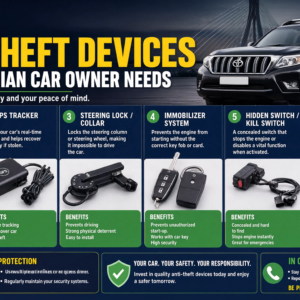
Complete ownership transfer and registration. Obtain at minimum third-party insurance — though comprehensive insurance is strongly recommended for a vehicle of this value. Get a vehicle tracking device installed (₦30,000 – ₦80,000 for device and installation) — this is non-negotiable for cars worth ₦2 million or more in Nigeria’s current security environment.
Week 3–4 — Fuel and Driving Habits:
Understand your car’s fuel consumption. Most 4-cylinder sedans in this price range will return 8–12 litres per 100km in real Nigerian driving conditions (Lagos traffic will push this to the higher end). At current fuel prices, budget your monthly fuel costs honestly before they surprise you.
Annual Ownership Cost Estimate for a Toyota Camry (₦3.8M purchase price)
| Annual Cost Item | Estimated Cost |
|---|---|
| Fuel (average 1,500km/month, 10L/100km, ₦1,000/L) | ₦1,800,000 |
| Insurance (Third Party) | ₦30,000 – ₦50,000 |
| Annual Service (oil, filters, etc.) | ₦80,000 – ₦150,000 |
| Tires (prorated, replace every 2–3 years) | ₦50,000 – ₦80,000 |
| Miscellaneous repairs | ₦100,000 – ₦300,000 |
| Vehicle licence renewal | ₦15,000 – ₦25,000 |
| Estimated Annual Total | ₦2,075,000 – ₦2,405,000 |
This is why choosing a fuel-efficient vehicle matters enormously in Nigeria. Fuel is your biggest ongoing cost by far.
FAQs: Your Most Important Used Car Questions Answered
FAQ 1: Is it better to buy a tokunbo car or a Nigerian-used car?
It depends entirely on the specific car’s condition and history, not just where it came from. A tokunbo with a clean CARFAX history, low mileage, and no accident record is generally preferable. However, a well-maintained Nigerian-used car from a private individual with full service records can be equally reliable. The inspection process is exactly the same for both — don’t skip steps simply because a car is “just-arrived tokunbo.”
FAQ 2: How do I know if a car was previously in a flood in Nigeria?
Flood damage is a serious and common issue in Nigeria. Signs include: musty or mouldy smell inside the cabin, staining or mineral deposits under floor carpets, rust on hard-to-reach metal components (under seats, in the boot), corrosion on electrical connectors and fuse boxes, and a general “damp” look to sound-deadening materials. Also check the seatbelt housing — floodwater typically leaves residue at the level the water reached.
FAQ 3: Should I trust cars sold by military or government personnel?
Not automatically. Government and military fleet vehicles are often heavily used, with high mileage driven hard on poor roads. The seller’s status doesn’t guarantee the car’s condition. Run the same full inspection regardless of who is selling.
FAQ 4: What’s the safest way to buy a used car online in Nigeria in 2026?
Use established platforms with buyer protection (Cars45, Autochek offer graded vehicles with inspection reports). For private listings on Jiji or Facebook, never pay any deposit before physical inspection. Always meet in a public, safe location for initial meetings. Bring a mechanic for any serious inspection. Complete payment only after full inspection and documentation review — ideally at a bank during business hours.
FAQ 5: How many kilometres is too many for a used car in Nigeria?
Mileage matters less than maintenance history. A 120,000km Toyota Corolla that has been properly serviced is far better than a 60,000km one that never had an oil change. However, as a general guide: under 80,000km is ideal; 80,000–150,000km is acceptable with careful inspection; over 150,000km requires very careful mechanical evaluation, especially of engine and transmission health.
FAQ 6: Do I need comprehensive insurance or is third-party enough?
Third-party insurance is the legal minimum in Nigeria and covers damage you cause to other people’s property. For a car worth ₦3–5 million, comprehensive insurance — which also covers damage to your own vehicle, theft, and fire — is strongly recommended. Yes, it costs more (typically ₦80,000–₦200,000+ annually depending on the car’s value), but it’s genuine financial protection for an asset of this size.
FAQ 7: What should I do if I discover a problem with the car after purchase?
Prevention through thorough pre-purchase inspection is your best protection, as Nigerian consumer protection laws for private vehicle sales are limited. If you bought from a registered dealer, you may have recourse through their warranty or return policy — read the terms carefully before signing anything. If you bought privately, your options depend on what was represented in writing at the time of sale. This is why keeping all communications (WhatsApp messages, written agreements) is important.
FAQ 8: Is it worth buying a used diesel car in Nigeria?
Diesel vehicles (particularly SUVs and pickup trucks) offer excellent fuel economy and torque for heavy loads. However, diesel fuel quality in Nigeria has historically been inconsistent, which can damage fuel injection systems — repairs are expensive (₦200,000+). High-quality diesel is more consistently available in major cities than in rural areas. For city driving, modern petrol vehicles with good fuel economy are generally simpler and cheaper to maintain.
FAQ 9: How do I find a trustworthy mechanic to help with a pre-purchase inspection?
Ask for referrals from trusted friends, family, or colleagues who own similar vehicles. Brand specialist workshops (Toyota dealers, Honda specialists) will know the specific model better than generalists. Avoid mechanics recommended by the seller — they have a conflict of interest. CarWise.ng maintains a directory of vetted automotive service providers across major Nigerian cities.
FAQ 10: Can I negotiate the price if I’m buying from a certified dealer?
Yes, always try — even with certified dealers. While their margins are tighter than open market sellers, most dealers have some flexibility, especially if the car has been in their inventory for a while. Ask specifically about: dealer fees (which are sometimes separable from the vehicle price), whether they’ll include a service or fresh tires in the deal, and whether there’s flexibility on the payment timeline if you’re not paying all cash.
Conclusion: Your Smartest Car Purchase Starts With What You Now Know
Let’s bring this home.
Buying a reliable used car in Nigeria under ₦5 million is absolutely achievable — but it rewards preparation and punishes impatience. The buyers who get burned are almost always the ones who skipped steps: didn’t inspect properly, didn’t verify documents, didn’t bring an independent mechanic, or let urgency override good judgment.
You now have tools that most Nigerian car buyers don’t:
✅ A realistic budget framework that accounts for the true cost of ownership
✅ Clear guidance on which vehicles have proven track records on Nigerian roads
✅ A comprehensive inspection checklist covering every major component
✅ Knowledge of every scam you’re likely to encounter
✅ A document verification framework that protects you legally
✅ Negotiation strategies that are based on facts, not guesswork
✅ Post-purchase steps that protect your investment from day one
Here are your next steps, in order:
- Set your total budget (not just purchase price) and stick to it
- Research current prices on at least three platforms before shopping
- Choose 2–3 target vehicles based on reliability, parts availability, and your budget
- Find a trusted independent mechanic to accompany you on serious inspections
- Run a VIN history check on any tokunbo vehicle before you get emotionally invested
- Complete all documentation before transferring a single naira
- Baseline service the car within the first week of ownership
The Nigerian roads are tough. Fuel is expensive. Mechanics vary wildly in quality. But a well-chosen, properly inspected used vehicle, bought smartly and maintained consistently, will serve you faithfully for years — and that’s exactly the kind of vehicle this guide helps you find.
Have specific questions about a vehicle you’re considering? Drop your query in the CarWise.ng community forum, or browse our current vehicle listings to see what’s available in your budget today.
Published on CarWise.ng | Updated for 2026 market conditions | Written by the CarWise.ng Editorial Team
Disclaimer: Prices quoted in this article reflect general market conditions as of early 2026 and may vary significantly based on exchange rate fluctuations, location, and individual vehicle condition. Always conduct independent research and consult qualified professionals before making any vehicle purchase decision. CarWise.ng does not endorse any specific seller, dealer, or platform mentioned in this article.